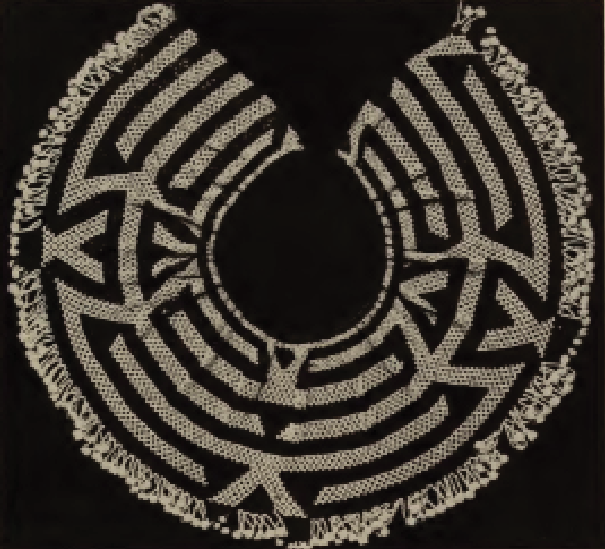
An historic example of a beaded cape of the Mojave.
Smithsonian National Museum of the American Indian.
by Kim Garrison Means
Personal adornment has sprung up in every society on our planet, and has followed us since the beginnings of humanity. The earliest evidence of a cache of pigments that could have been used for body painting were found in Zambia, Africa, in 1996. They were 200,000 to 400,000 years old. We humans have been distinguishing ourselves visually as individuals and members of specific groups for quite a long time, and we’ve woven our history, cultural identity, spirituality and our environment into our jewelry, clothing and body adornments.
Beads were discovered and used independently by multiple civilizations over the millenia. Being beautiful, symbolic, easily transportable and spiritually significant meant that beads were also valuable as a trade item, and they have been passed around the world since their oldest recorded time of use, about 150,000 years ago in Morocco. The first beads on record were made of bone, shell, seed, wood, antler and stone, but by about 5,000 years ago, they began to be produced through sophisticated processes. Beads found in the Indus Valley of South Asia around 3300-1300BCE were similar to many that are made today, formed from gold, silver, copper, and semi-precious stones.
The oldest beads discovered in the Americas were rabbit bone, found in Wyoming, and they date back about 13,000 years. As large civilizations like the Mayans, the Aztecs, and the Ancestral Puebloans developed, the people in these societies created and wore beads of gold, silver, jade, shell, amber, jet, pearl and turquoise. Bead-decorated clothing and jewelry had significant symbolic value to ancient Americans and was used for religious and protective purposes, as well as for looking fabulous.
The Ancestral Puebloan people of the American Southwest (including those that lived in Southern Nevada) created and traded beads with communities from the Pacific coast in California down into Mexico. Turquoise was especially prized for its associations with protection and the sky, and it paired nicely with bright spiny oyster and shiny abalone from the west coast. The Mojave were also famed as long-distance runners, trading with both the California Coast and the Pueblo/Four Corners region. Ancient beads made of natural materials often took long hours to make with basic tools, adding to their value and prestige, and trading them became a form of currency in the region.
The first glass beads were made by the Egyptians about 5,000 years ago, and reached the Americas with Columbus in 1492, when, according to his own diary, he and his crew distributed them as gifts to the people they met, in order to gain their trust and facilitate trade. The American West was introduced to glass and coral beads a little later, by the Spanish in the 1500s, and the bright colors of these beads quicky gained popularity. Larger, opaque glass beads called “pony” beads were popular in the early 1800s, named for the ponies that carried the trade goods on their backs. Finally, around 1840, smaller “seed beads” became available, and allowed for the more delicate design work we see in many Native American designs today.
Beadwork, which is the art of arranging beads through weaving, sewing, embroidery or crochet, rather than just stringing them, has examples dating back over 6,600 years in Egypt and Mesopotamia. Native American tribes have each developed their own traditions of weaving and beading techniques, and incorporated new materials into their designs as they became available. They also borrowed heavily from each other, adapting one another’s techniques and symbols.
For the Plains Indians (like the Lakota and Cheyenne) who hunted bison, deer, elk, and other large mammals, leather goods were plentiful, and their beadwork traditions centered around embroidering clothing items, bags and hide blankets with beaded designs, sewing them in with sinew. Porcupine quills were easy to acquire and, as they were hollow, they made excellent beads with little effort.
In contrast, the Mojave, Quechan, Maricopa, along with other Colorado and Gila River Tribes did less hunting of big game, and instead fished and planted crops. They had less access to materials like leather and sinew, but had long traditions of weaving fishing nets, sandals, mats, baskets and clothing from yucca and other strong plant fibers. The traditional beadwork capes produced by these tribes and their neighbors (Southern Paiute communities) are structurally related to the traditional looping and tying techniques they used to create fishing nets and other woven objects, and they share the same diamond pattern as these ancestral fishing nets. In addition, these river communities adorned themselves with body paints ground from colorful local minerals, and some of their later geometric beading designs may have been translated from this practice.
The mid-1800s was a time of many changes, and local tribal communities were disrupted by the presence of newcomers to the area. The conflicts involved led to an incarceration period for many tribes, and the communities that lived along the rivers were forced to abandon some of their established methods of survival, farming, and plant gathering, as they were pushed off of their traditional territories and onto forts or reservations, and made to subsist on government food rations while learning the ways of a foreign culture. This also brought about changes in local body adornment practices, as body painting and tattooing was discouraged and the wearing of Western clothing was promoted.
With the arrival of the Atchison, Topeka and Santa Fe railroad in the late 1800s, beadwork that was once given as gifts or traded mainly within tribal communities was suddenly valued as a tourist item by outsiders from all over the country. The Fred Harvey Company, which served railroad passengers with cafes, hotels, and gift shops, heavily promoted the concept of traveling through the Southwest to see the wonders of the western landscape and visit Native American cultural sites. Harvey touted the skill of Native arts and crafts, and set up demonstrations of weaving and jewelry-making inside his gift stores to promote sales.
During the early 1900s, women from the Mojave tribe sold beadwork, ceramics and dolls at the train station in Needles, California, in order to help support their families. While the selling of this artwork as a commodity to outsiders was bitter, and disrupted the spiritual aspects of artmaking and gifting, it also helped the techniques of these artforms survive into the next decades, at a time when so many other cultural, spiritual and language practices were forbidden and were subsequently lost.
Looking back on the full history of beadwork and body adornment, it is interesting to note that the techniques used today by the Mojave, our area’s River Tribes and Southern Paiute communities to create beautiful and spiritually meaningful body adornments are the same techniques used in earlier times to keep their ancestors fed and warm, so they could pass on their genes and their knowledge to their descendants. And it seems as if that story is much the same throughout the world. With every thread, loop and knot of a bead, there is a continuum that reaches back through the ages and beyond memory, passed down from person to person, century to century, millennium to millennium, tying us all to the past, present and future in an invisible net of connections. Let’s hope that there is a resurgence in the popularity of these artforms, so these skills can continue to be learned and enjoyed by generations to come.