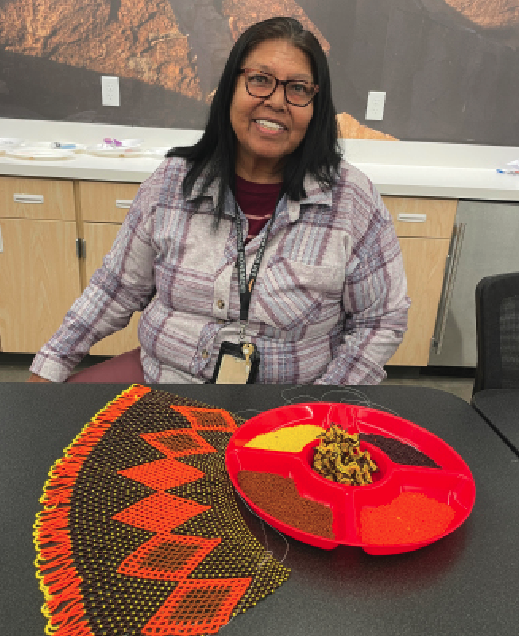
Marla Jenkins, sitting with a beaded cape she is beading.
Dec 4th, 2025, Fort Mojave, AZ
I learned beading from my mom. She’s from Parker, Arizona. She made all kinds of designs.
I bead because it makes me feel at peace in myself. I think I watched my mom and learned a lot. Beading makes you feel connected to your spiritual self. You go through things every day in life, so I turned to beading. I enjoy doing it, but it is hard on your eyes and your hands.
We try to bead how we feel. Right now, I’m going through grieving, so this is my peaceful thing. It helps me to feel better in my heart. I can’t just bead because I want to do it, I have to feel right in my heart. It’s a spiritual thing. That’s how I see it.
I don’t really have patterns. What comes up is what I see. Mother Earth, the colors from the sun, the rocks, the dirt, and everything is about how creation became. That’s how my beading is, I see the fields, the wheat, the alfalfa. When the seasons change, that’s when I pick up the colors. I did a cape that is blue and white for the river, with the ruffles for the water.
I don’t copy anyone’s designs. We beaders have our own designs. We are in clans. I grew up in Parker, my dad was the mus clan. He passed away and I was raised by a single parent, my mom. She was independent and I became independent. She did a lot of sewing. I didn’t grow up with electronics, so mostly I played out in nature, with the mud, the rocks and trees. I didn’t have basketball or anything, but played out on the farms where we lived. It was just open, by the peanut fields, the plantings that were around me. Then we swam in the canals. So now, I realize everything I work on is about nature.
Then I married and came here to Fort Mojave. I saw the river, and I liked to go by the river. Then I made a cape, because I saw the earth, the sky, the blue, the clouds, the blue-green water. So that’s what my version of the beadwork is. The diamonds are on there – everyone has their own colors and designs that they pick.
In this piece, I was thinking about the sun. When I get up in the mornings, I pray, and again when the sun goes down. Everything is a gift, every piece. I do sewing too. I sew dresses and do my own designs, see what the colors are. It brings out yourself. My uniqueness is different. It’s not like anyone else’s. You can’t be like anybody else. I see these visions myself. I bead like that. I make Y necklaces too. This is an old design from the elders. From generation to generation this was passed down. And they called it a Y because it was designed to split like a Y. The symbol was a Y, and it used to be different, it just had a little bead right in the middle and hung down. But now we have designed it so that it is a ladder and has fringe.
These are the necklaces that we made as gifts for the Avi Kwa Ame designation celebration, to give to people who helped protect the land. We made a lot, 50? 150? And the beads are sometimes handed down or somebody gives us beads. My mom made a lot of dolls too, Mojave dolls. Everything, when a person passes, it goes with them. You can keep it or pass it down, or it can go with them. She did a lot of beadwork, but it all went with her.
After that, it took a while for me to get back into beads. As soon as I came here to Fort Mojave, (in the 1970s) I had to pick it up again, and then it came back to me. It is repeatedly done, so once you get the hang of the number counting, then you can do different designs. We put the design on paper first, and then we can look at that. But the number count is important and the threading, we have to make sure we have enough of all of the colors, because you’ll never find that color again.
I learned from Sherry Hemmers at the Culture Society, but we all do our own designs. When we teach it, it is separate. Some sell, some don’t, some are gifted. It’s up to us. We always keep the first one we make. I help teach the different ages of students, we show them and help them, and a few have picked it up, and then they continue. We can have 50 students, and there will only be a couple that learn.
Beading started with trade beads when the railroad came. Mrs. Barrickman, who was my aunt, did a lot of beadwork. She taught too, and I went to some of her classes. She was a professional beader and made a lot of work. It went down from generation to generation. I think the beads came from trading but some of the techniques, like in the capes, would have been the same as other crafts, like making fishing nets.
The designs on some of the earlier beadwork had pictures that represented the artist or their clan, some had animals and symbols, like the pictures Paul Jackson paints. I see old ones that have been returned to the museum, they might have a swastika (Thunderbird) design on them that’s very old, and the beadwork material might only be primary colors, red, yellow, blue. Back in the 1970s, we used to call this salesman who would come round in a car, way around the reservation from house to house, he’d have kitchen ware, materials, scarves, whatever, and he’d have beads.
The patterns and designs in our collection, they were probably done by how people saw things. People migrated. Some of the designs are very old. Today, there aren’t that many beaders, and it is getting scarce. There are probably dozens, not hundreds, of people who still know how to do it. We share what we know here at the cultural center, so hopefully some people pick it up. People from Fort Mojave come here to bead and learn. That’s what we are here for, we can show them and share techniques and materials so they can finish their projects.
Beading is who I am today, a part of my identity as an elder. It shows me that I have talent. If I gift a piece to somebody and I see them wear it, I know they are wearing it because they like it, and it makes me feel like they’ll remember who I am. That’s what I feel when I see a project or I gift it to someone.
The younger ones go away to school now, and the first questions they get are “what tribe are you from? Can you speak your language or make something?” I try to pass beading down to my granddaughter. She can make Y necklaces, and earrings, and she knows how to dance, and make dresses. She learned by watching. I don’t think I had to show her these things, she just picked it up. All of these things accumulate. I’m happy to see when a child comes and learns about our language and learns to bead something, and they are all happy and gift it to mom or dad. That makes us all happy here, and then they want to come back again, and that’s the thing that counts.