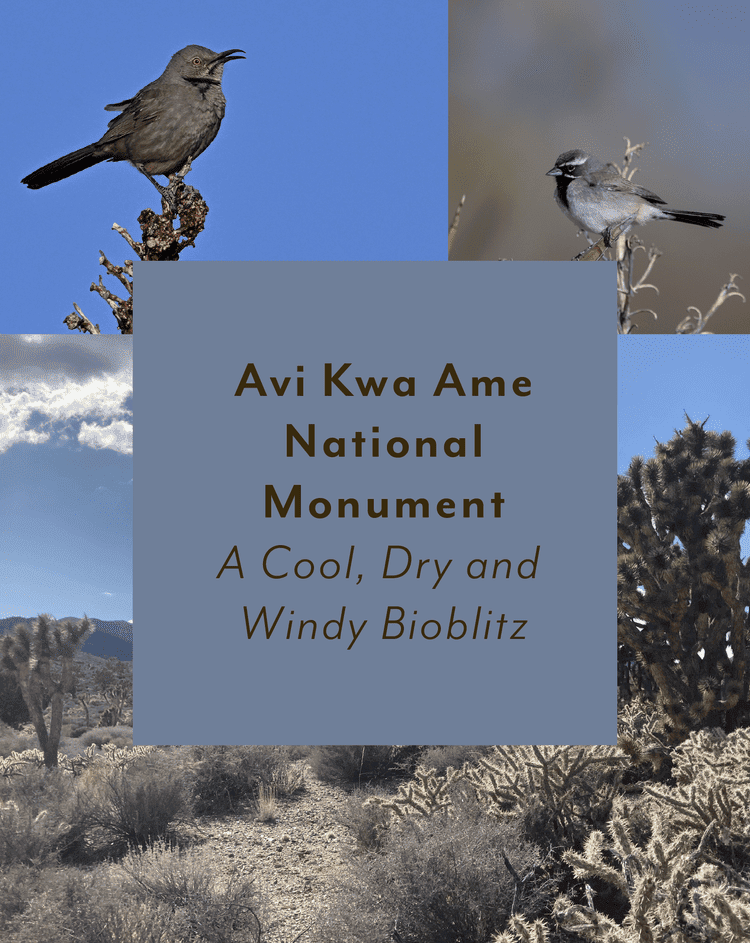
Avi Kwa Ame National Monument ~ A Cool, Dry and Windy Bioblitz
My quest for birds also brought me to higher elevations within the monument, and as I approached the foothills of the McCullough Mountains the vegetation began to get noticeably greener. There was a detectable increase in bird activity at these elevations, with migratory flycatchers, sparrows, and warblers actively feeding and replenishing their stores to continue their journeys. The melodious song of a Scott’s Oriole rang from an adjacent Joshua Tree-studded ridgeline. Once I reached the spring I was headed for, I found many more species of migratory songbird. But I could not stay long, and as I descended back to lower elevations the desert once again dried up and the birds seemed to disappear.
Despite dry conditions forcing birds into secrecy and the weather turning worse on day two, the ThrasherQuest went remarkably well. We found multiple new territories for both LeConte’s and Bendire’s Thrasher, which will serve as research opportunities for GBBO biologists when we return in the future. Over the course of the weekend, many bioblitzers surveyed washes, canyons, nooks, and crannies of the monument and inventoried a stunning 317 species of plant, bird, lichen, reptile, mammal, and invertebrate. There’s still time to add more—the bioblitz will be collecting observations until the end of spring on June 20th!
MAY 2025
This month’s seasonal update (and the photos above) are brought to you by Ned Bohman of the Great Basin Bird Observatory! More gorgeous photos from social-media skeptical Ned can be found here.
This year we celebrated the second anniversary of Avi Kwa Ame with a bioblitz. A phenomenally action-packed weekend of all things biotic, and some abiotic, within the monument.
On day one of the 2025 Spring Bioblitz of Avi Kwa Ame, it was 40 degrees at 6:00 AM, and the wind was going steady. This did not bode well for ThrasherQuest, an organized effort to locate and study desert thrashers (more about these special birds and the effort to study them here). While the desert was extraordinarily quiet, almost spookily devoid of birdsong, our questers did manage to find LeConte’s and Bendire’s Thrashers on the first morning of searching. At the lower elevations, and preferred habitats of thrashers, many shrubs were in a state of dormancy to reduce water loss. Black-throated Sparrows were floating around in groups of 4-6 birds, and other species were few and far between. Desert Thrashers are adapted for life here. Their secrecy conserves energy, and they get all their liquid water from the foods they consume.