Springtime for Birds in Avi Kwa Ame
By Spencer Giesemann
AS NIGHT BREAKS AND THE MORNING SUN SHINES over the mountain ranges, filling valleys and canyons with light, beautiful melodies of bird song are carried by crisp spring winds. Each bird, in each setting of Avi Kwa Ame, from mountains to washes or cholla gardens, has a completely different set of strategies and skills they use to navigate life in the harsh Mojave Desert. Since the beginning of humankind, we’ve recognized these unique behaviors, and birds have played significant roles in our culture and our connections with nature, transcending time and geographic boundaries. Birds have been our teachers and our scientific and creative muses. We have always been inspired by them, and strive to innovate from their examples, propelling humanity forward.
Avi Kwa Ame is home to many unique and wonderful birds for us to find and enjoy. In the spring, migration routes carry countless species through this landscape, some passing through, and others intent on raising their next generation of young in the canyons, valleys, and arroyos within the monument. Watching birds closely, we can observe their stories of adversity and resilience, playfulness and companionship, and learn from the joy, peace and connections with their surroundings that they demonstrate on a spring day.
From the center of Searchlight to the farthest boundaries of Avi Kwa Ame, mourning doves, black-throated sparrows, great-tailed grackles, and Gambel’s quail are easily the most common and widespread of all the birds found in the monument. Mourning doves are perhaps the most prolific bird in North America. They aren’t difficult to find, as their characteristically simple gray-brown plumage with black spots on the wings, and their long tails make them easily identifiable. Their name suggests a measure of sorrow but is appropriately likened to the soft descending coo of their song. While exploring the monument, one might also hear a sharp whistle of their wings as they speed like bullets overhead. Black-throated sparrows are undoubtedly the most common bird in Avi Kwa Ame; they are one of the most striking birds in the Mojave, known for their bold black throat, contrasted by two white facial stripes: one above the eye and the other below on an otherwise soft gray-brown body. These sparrows sing like tinkling bells. They nest in all sorts of low shrubs, cacti, or other dense and well-protected plants, but can be seen foraging on the ground for seeds, which are the primary source of their water. Washes often serve as a bountiful year-round cache for seeds that gather there from rain and wind for the black-throated sparrow to survive on through times of drought.
The great-tailed grackle is a cacophonous bird often found in noisy groups, creating a harsh and audible chorus for nearby observers to enjoy. As their name suggests, they have a large, broad tail: in flight it looks as though it slows their momentum, making it difficult to fly, but the tail’s main purpose is for attracting mates.
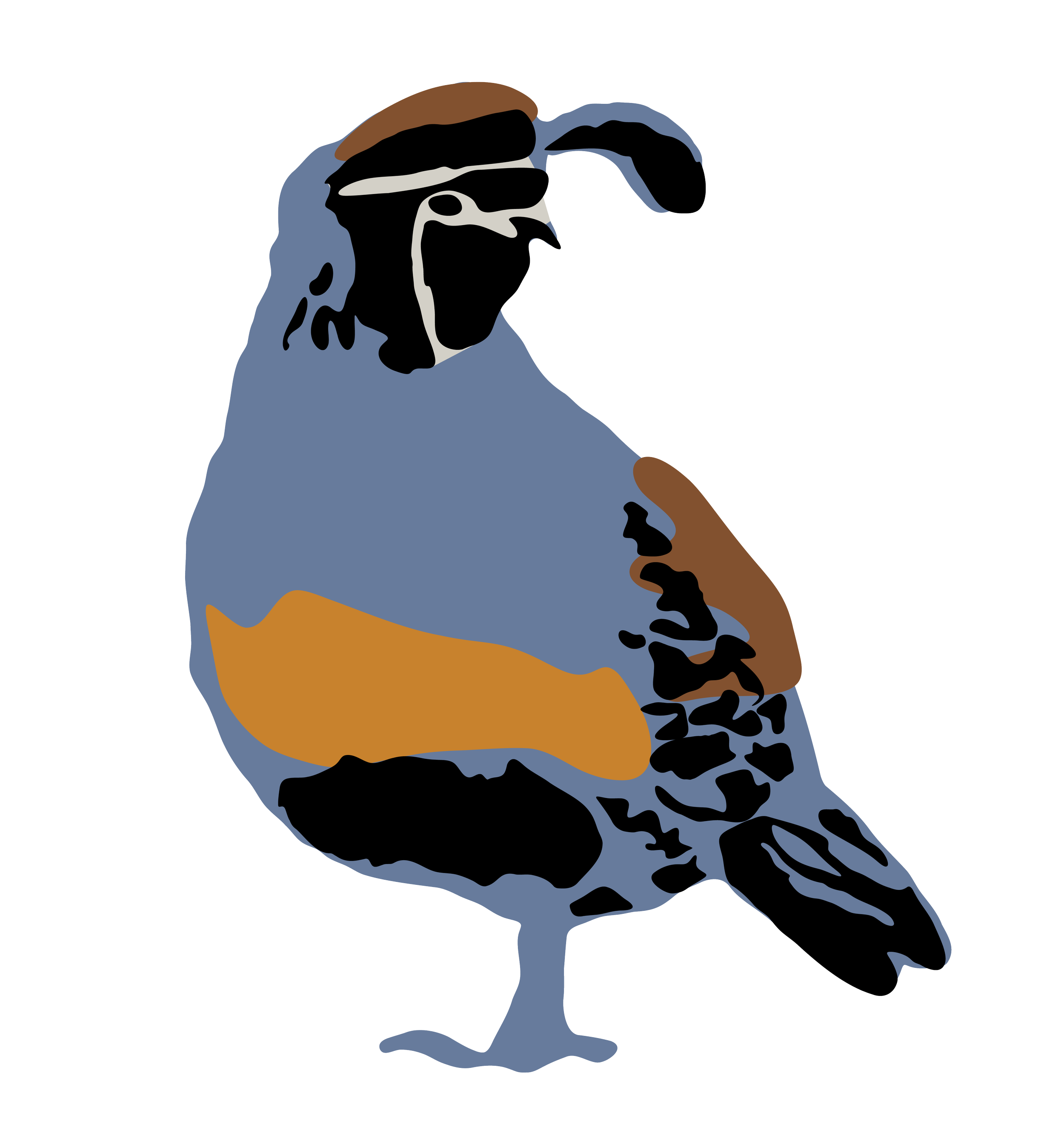
One of the most endearing birds is the Gambel’s quail. They are most often spotted scurrying along in trailing family groups of up to 15 newly hatched chicks behind their trusted parent. There is safety in numbers for these birds. When they hatch, Gambel’s quail leave no kin behind. As the first chick begins to escape its egg, it lets out light pips, signaling its brothers and sisters to follow suit. The chicks then peck small windows in their shell, and patiently wait for all their siblings to signal their readiness. And then all at once, the dozen or so chicks break through their shells at once, taking in their first breaths, ready to run.
Walking Box Ranch lies in the heart of the monument, west of Searchlight and just south of the impressive Wee Thump Wilderness. The ranch has stood strong since the early 1930s, when Clara Bow and Rex Bell moved in, but an older chronicle exists of the birds that now inhabit the eaves structures there. A likely sighting at the ranch is the Say’s phoebe who are quite familiar with man-made structures as they rely on overhanging cover from roofs for nesting. A fly-catching species, Say’s are small, gray birds with cinnamon bellies and a pale gray throat. They can be seen as they sally from fence posts and low bushes to catch their insect prey.
Flickers, on the other hand, are obliged to nest in cavities, and the large and dense Joshua tree forest surrounding Walking Box is their most suitable home. In Avi Kwa Ame National Monument, it’s possible to see two different species of flicker: northern and gilded. The two birds are very similar in appearance, with hefty, slightly curved bills, and large bodies covered in black spots or bars. As the name suggests, gilded flickers are bright yellow under the wings and tail, while northern flickers display rich, orange-red hues. The flicker makes its presence known through a distinctive kyeer call. Catching a glimpse of a gilded flicker is a rare and precious encounter; like finding gold in the desert.
The cavities carved by flickers and woodpeckers are also the perfect home for the smallest falcon in North America, the American kestrel. A slate-blue and rufous colored bird, kestrels can be seen along highways or in the open shrublands of the desert on a high perch, or while hovering in midair, almost perfectly still, as they scout the land for grasshoppers, rodents, or small birds. Soaring higher over the valley, one can spot the red-tail hawk as it flies aloft columns of hot air while scanning the landscape for prey. In flight one can see its white wings with dark shoulders and a prominent, rufous red tail. When the light hits its tail just right, it seems to glow with a bright flame.
People don’t often appreciate the flat, far-reaching desert that is the Piute Valley. Just south of Searchlight, it’s woven with sandy washes lined with creosote and cholla, perfect habitat for dozens of species. Phainopepla are the romantics of the desert. A glossy black bird with white patches on its wings, phainopepla evolved closely with desert mistletoe and even display a stunning red eye to match the plant’s quintessential berries. To most birds, the vibrant red berries are toxic, but to phainopepla, it’s a primary food source high in nutrients. They ingest the fruit and deposit the seed in acacia or mesquite across the desert, ensuring a secure food source and nesting sites in years to come. Curiously, phainopepla exhibit a great deal of flexibility in mating behavior. Nesting in the desert in the early spring, mating in the higher elevation oak-scrub woodlands in summer, or possibly both, or neither, depending on resource quality and conditions.
A vocal species, ash-throated flycatchers move into the valley during the spring, taking advantage of the abundance of flying insects. Ash- throated are small songbirds, with a characteristically ashy gray throat, a darker gray crest, long cinnamon tail, and a muted yellow belly. They blend in well with their perches, but are curious about people and will occasionally perch near a hiker to investigate. They release a frequent sputtering of pips and burrs while curiously twitching their head side-to-side. Listen for an audible snap while they’re hunting; that’s their beaks clapping shut around their prey.
Western kingbirds are the plus-sized relative of the Ash-throated. They look similar, but western kingbirds are more robust and more vibrantly yellow on their breasts and bellies. They lack any cinnamon color, and the white edges of their tails are easily spotted as they fly overhead. Kingbirds are proud, like their name suggests, and will aggressively scold any intruders or competitors, animals and humans alike.
In the sparse shrublands and open fields of the Piute Valley, horned larks scuttle along the ground, looking for seeds and insects. They’re small, slender birds, mostly brown aloft and white below, with black masks and ‘horns’ poking up from their round heads. Spotting small dust clouds rising from the dirt during early spring is characteristic of a female performing a courting display, though it might be mistaken for a dust bath during other times of the year.
One of the sweeter songs in Avi Kwa Ame comes from the verdin, a restless songbird likened to a chickadee of the desert. During breeding season, a honeyed deet-doot-doot song can be heard from these yellow-headed rascals as they boldly announce their territory amongst the mesquite and creosote filled washes. Their nests are small and twiggy closed spheres lined with grasses or plant fibers. Placed conspicuously in the outer limbs of plants like acacia, they have a low opening facing the prevailing wind to ventilate the structure in the scorching heat.
To the north, the El Dorado Valley stretches over rocky scrublands, littered with flecks of orange and yellow from wildflowers, until it eventually reaches Copper Mountain Solar Facility, one of the largest in the nation. The greater roadrunner is perpetually evasive, as it darts from cover to cover, it might be seen speeding through washes or across one of many OHV trails running through the monument. They rapidly scurry across the expansive flatlands, searching for lizards and small mammals. Catching a lucky glimpse of one of them rewards the keen eye with a view of their impressive black crests, their brown and white mottled bodies, and long tails that help them balance as they sprint.
On the perimeters of the valley, as the terrain gets rockier and mountainous, rock wrens offer a cheerful, springy song – with their equally springy bodies - to the morning sun, as they scramble around the foothills of mountains and canyon walls. As they hop between the boulders, these wrens search for insects in cracks which they carefully glean with their slender beaks. While rare in the monument, golden eagles are majestic, high-soaring birds with sharp talons, beaks, and eyes, a necessary set of traits to facilitate their cliffside hunts as they sail above the nearby Colorado river looking for jackrabbits and other small mammals to prey upon. Golden eagles are named for their opulent yellow-gold nape, framing their head like a lion’s mane. Since these eagles are so large, they often require updraft from cliffs or canyons to provide the necessary lift as they take off from high perches.
Towards the eastern boundary of Avi Kwa Ame, the gentle slopes holding thousands of teddy bear cholla on the way to Cottonwood Cove are home to an equally impressive host of feathered animals. LeConte’s thrashers stay low in dense cholla gardens and run along sandy washes, looking for invertebrates to eat. They are a pale gray bird with a long, slender tail, a black, steeply curved bill, and black eyes. They build robust nests barely off the ground, sometimes decorated with small yellow flowers around the rim, deep in a cage of cactus as a fortress for their young.
High in the sky, turkey vultures ride thermals above Cottonwood Cove Road, waiting for an unfortunate car strike to provide them food or for an animal to succumb to the intense pressures of the Mojave. They look almost like the carrion they feed on with a wrinkly red and bald head, and ominous black body. They might congregate in large groups, perched in large cottonwoods or mesquite tracing the banks of the river or soar independently, with their wings cocked in a distinct V-shape.
The York Fire burn in 2023 left a once magnificent forest of Joshua tree in ruin, but in the time since, the colorful flowers that have emerged from the desolation prove a striking sight against the backdrop of charred landscape. Fortuitously, the birds have begun to return, including the common sparrows, quail, and doves.
Possibly the most obvious bird, the northern mockingbird, loudly and irreverently dominates the desert choir. They perch conspicuously atop Joshua tree or acacia and sing incessantly as they mimic the songs of others from the desert. Unlike some songbirds, Mockingbirds evolved to expend their energy on singing to attract mates, instead of into bright colors and fancy plumages. While their slender gray bodies, long tails, and yellow eyes might seem understated, their mating displays, in which they flip between phrases of their song while perched, are a remarkable sight.
More gracefully, great horned owls fly swiftly and silently into the night air. They are regal and commanding: their deep hoots, piercing yellow eyes, and ear tufts make them an intimidating predator of the night. The burn scar allows for a greater visibility of the desert floor, which these owls take advantage of while hunting for rodents. These owls can detect the glowing urine of their prey with special UV receptors in their eyes, allowing them to follow tracks of nervously piddling pack rats.
In the mountains, where the fire didn’t reach, there are patches of juniper trees safely tucked into the steep canyons. On these rocky, heavily-shrubbed slopes live the crissal thrasher. Of the five thrashers known to inhabit Nevada, crissal have the most dramatically decurved bill, resembling a sickle used for harvesting grain. They’re named after an area on a bird’s body called the crissal, just underneath the tail and at the base of their bellies, and these thrashers have a bold rufous color on theirs. They are a vocal species that sing melodiously in short phrases of two to three repeated notes and spend most of their time on the ground probing for insects.
In contrast to the scar left by the York Fire, just a few miles to the north, the Wee Thump Wilderness Area holds one of the greatest continuous Joshua tree forests with some of the largest in the world. Ladder-backed woodpeckers live here, who excavate their nests into the trunks of Joshua tree or large mesquite similar to the flicker. They get their name from the black and white horizontal barring on their backs, and are generally small with stout tails, and sturdy pointed bills. These woodpeckers are agile and difficult to spot; most of the time, they can be seen in the early mornings, scaling a trunk or briefly flying to a nearby tree. They contribute to the desert symphony with their sharp piik calls, resembling the noise a squeaky toy might make when stepped on.
Not quite as innocent and charming, loggerhead shrikes are a unique songbird that occupy the open shrublands in Avi Kwa Ame. Exploring the wilderness might offer a zip of black and white out of the corner of one’s eye, as these birds are swift and agile in pursuit of their prey. They vigilantly perch on the tall Joshua trees to prey on lizards, mammals, and other birds with their raptor-like skill. Sometimes they create a macabre display as they skewer their catch on a cactus, yucca, or one of the many barbed wire fences that dissect the land to more efficiently tear their victim apart into manageable pieces. If it proves too big a meal, the loggerhead shrike might leave their leftovers hanging until the next day’s breakfast.
A ghost of the desert, Bendire’s thrashers elude birders with their incredible camouflage and cryptic behaviors. Bendire’s are small, dusky brown birds with bright yellow eyes and faint streaking on the breast. Some might consider them a drab bird; however, their rarity makes them an expert level challenge when seeking wildlife. Searching long and low in shrubby washes, might lead to the coveted sight of a Bendire’s as it darts across the desert, possibly perching on a Joshua tree to sing one of their mumbled, but melodious songs. Bendire’s are thought to mate for life and finding one might lead to another nearby.
Cactus wren are another characteristic species of all Southwest deserts that are sometimes easier to hear than see; their repeated, guttural song sounds like a car’s engine turning over. These wrens have brown and white mottled bodies with a distinct, white eyebrow above their deep brownish red eyes. After a female selects the nesting site, the pair get to work building multiple nests, with some for nesting, and others to roost while keeping themselves coolly protected from the baking sun. They weave intricate football shaped nests of fine grass and straw, designed to insulate and shade its contents. After all, no bird appreciates cooked eggs like humans do. Utilizing a different strategy, Scott’s oriole delicately hang their finely woven basket nests about head height in junipers and Joshua trees, taking advantage of the cover. They have vibrant yellow bodies, a black hood and tail, and black wings with contrasting white wing bars. Seeing them is a treat, but possibly even more beautiful is their song. They are some of the earliest risers, singing before dawn through the morning, as they vocalize a series of sweet, melodious whistles.
To the southeast at the foothills of Spirit Mountain, lies the steep, colorful walls of Grapevine Canyon. Past the many ancient carvings, the cascading song of a canyon wren bounces off the narrow rock walls that converge into the canyon floor. These wrens have a delightful appearance, showing a rich, cinnamon body, vividly white throat, and a long, narrow bill. They are often seen flicking their cocked tails or playfully bouncing around the rocky cliff walls.
Hummingbirds are always the first to arise in the canyon, and notably before dawn. They immediately set on the hunt for rich nectar from the blooming wildflowers. These tiny-bodied birds have the metabolism of a teenage track athlete, pumping their wings at a steady 70-200 beats per second depending on the behavior, requiring a constant stream of sugar from any available nectaries. Both Anna’s and Costa’s hummingbirds boast a flashy gorget of purple or pink hues. Anna’s display a unique courtship dive: they fly straight up to 130 feet in the air and fall into a steep, vertical dive conjuring a loud squeak by the wind passing through their tail feathers.
In the evenings, a different cast of wild characters take the stage. As the kangaroo rats scurry, coyotes yelp, and pack rats search for food along the desert floor, the western screech-owl begins its hunt. These stout owls release an accelerating series of high toots that might sound like the cadence of a bouncing ball as it rebounds on a hard floor.
Lesser nighthawks soar into the air with long wings and small cylindrical bodies releasing a constant murmured trill into the night. They hunt for insects on the wing with their impressively large gape. Throughout the night, common poorwills announce their presence in the lowlands of the monument as they hunt for aerial insects in flight. Both species are unique in that they exhibit a behavior like hibernation called torpor. In the winter, when insects are scarcer, they decrease their metabolic activity for extended periods, but not quite to the extent of hibernation. In the day, both birds sit silently, expertly camouflaged as rocks. You might stumble near and startle them, subsequently noticing their disapproving grunts as they fly off to a more secure resting place. When night finally sets, while the mammals and owls are out, most songbirds rest, preparing for the challenges of tomorrow.
Springtime in Avi Kwa Ame features a captivating variety of common and charismatic species. There are well over a hundred that utilize this special patch of desert at any point throughout the year.
As the seasons change, so do the birds. In the late summer, after young birds have left the nest, they exhibit a blend of juvenile and adult plumage making them look different than others of their species. In the fall, many adult birds begin to lose their colorful breeding feathers in exchange for a duller look, allowing them to put energy purely into survival, as they prepare for the dangers of migration.
This cyclical plumage change, occurring in both the spring and fall, increases the challenge in identifying birds, but also increases the fun. The Colorado river corridor becomes an international superhighway for birds migrating to their productive breeding grounds up north, or to their wintering habitats in the south. Thousands of ducks, cranes, ibis, gulls, swallows, and songbirds follow the graceful curve of the Colorado as it carves through the southwest.
The river serves as a lifeline for many species, as it provides food and shelter in cottonwoods and willows during their arduous journeys. A visit to any of the shorelines or wetlands in the area offers sights of countless amazing birds on their migration and breathtakingly beautiful landscapes. Each bird offers a unique and treasured experience for all who visit, no matter the time of year. And when it is finally time to depart Avi Kwa Ame National Monument, it is easy to leave feeling the desire for a quick return, just as the birds do.