Rex Bell’s Nevada Legacy
BY N. RON SAFRAN
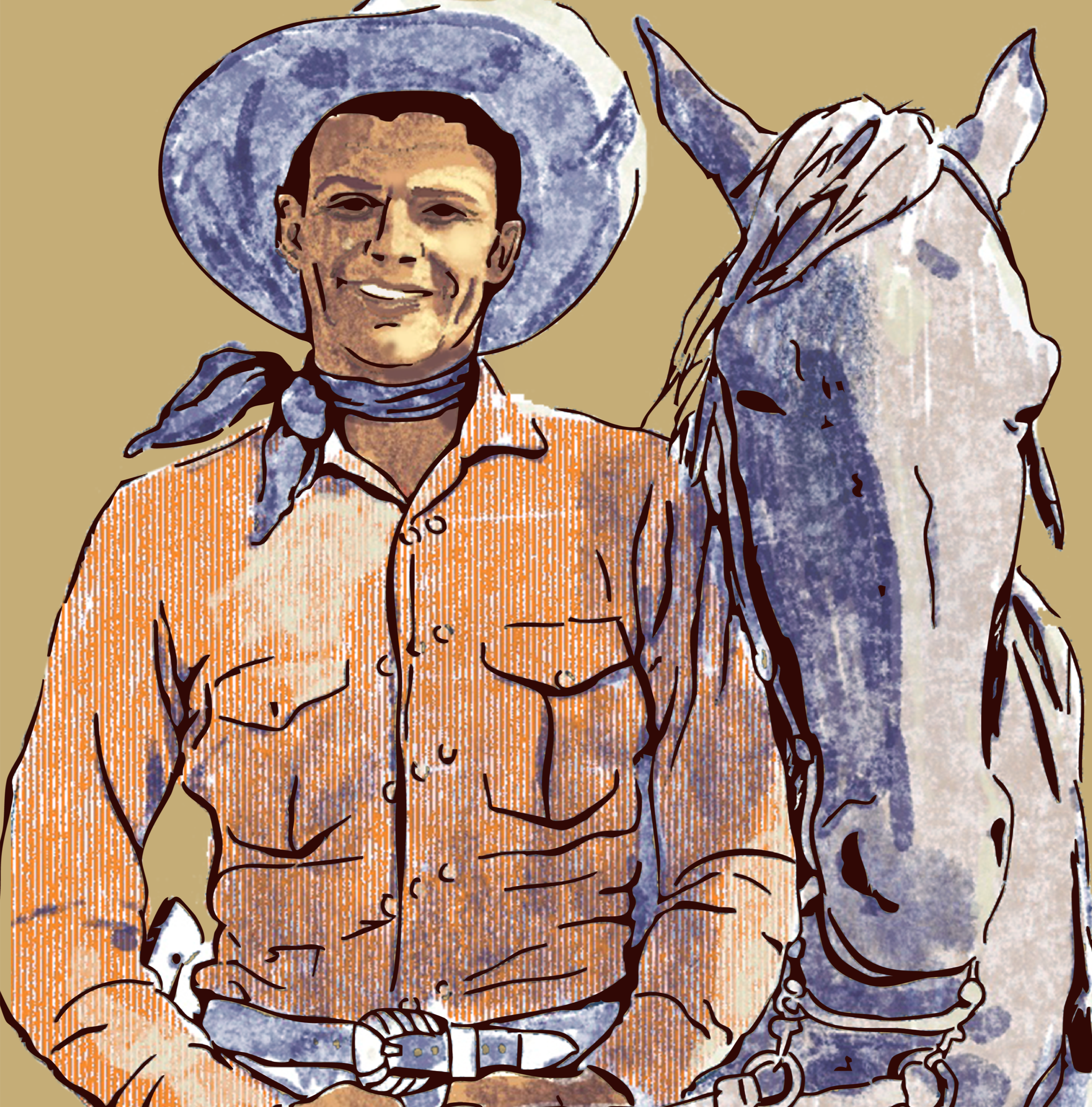
Illustration by Rachel Hillberg.
FROM STARDOM TO SAGEBRUSH: REX BELL’S NEVADA LEGACY
In the sweltering summer of 1931, as Rex Bell’s Lincoln Roadster kicked up dust along the primitive road to Searchlight, Nevada, a transformation was about to take place. Behind the wheel, Rex, known to millions as the star of their favorite Western films, knew himself to be a man ready for reinvention. The Hollywood movie sets, with their painted backdrops and choreo- graphed action, lay behind him. Ahead stretched acres of raw, unexplored Nevada desert—where no cameras rolled, and no director would yell “cut.” At last, he was not merely playing a part.
This article is a portrait of a cowboy film star who pursued his passion to be a real cowboy, businessman, and politician. Rex Bell’s life was a journey where his love for Nevada would catalyze his success in many ventures and help forge the state’s modern identity.
SUCCESS IN THE WESTERNS
George Francis Beldam Jr. embodied the intersection of Hollywood glamor and frontier authenticity that helped define Nevada’s unique character. His contributions as one of the first prominent characters in Nevada represent far more than a simple career change. They embody the very essence of what Nevada offered in those transformative years: the chance to shed prescribed roles and write one’s own story in the vast emptiness of the desert.
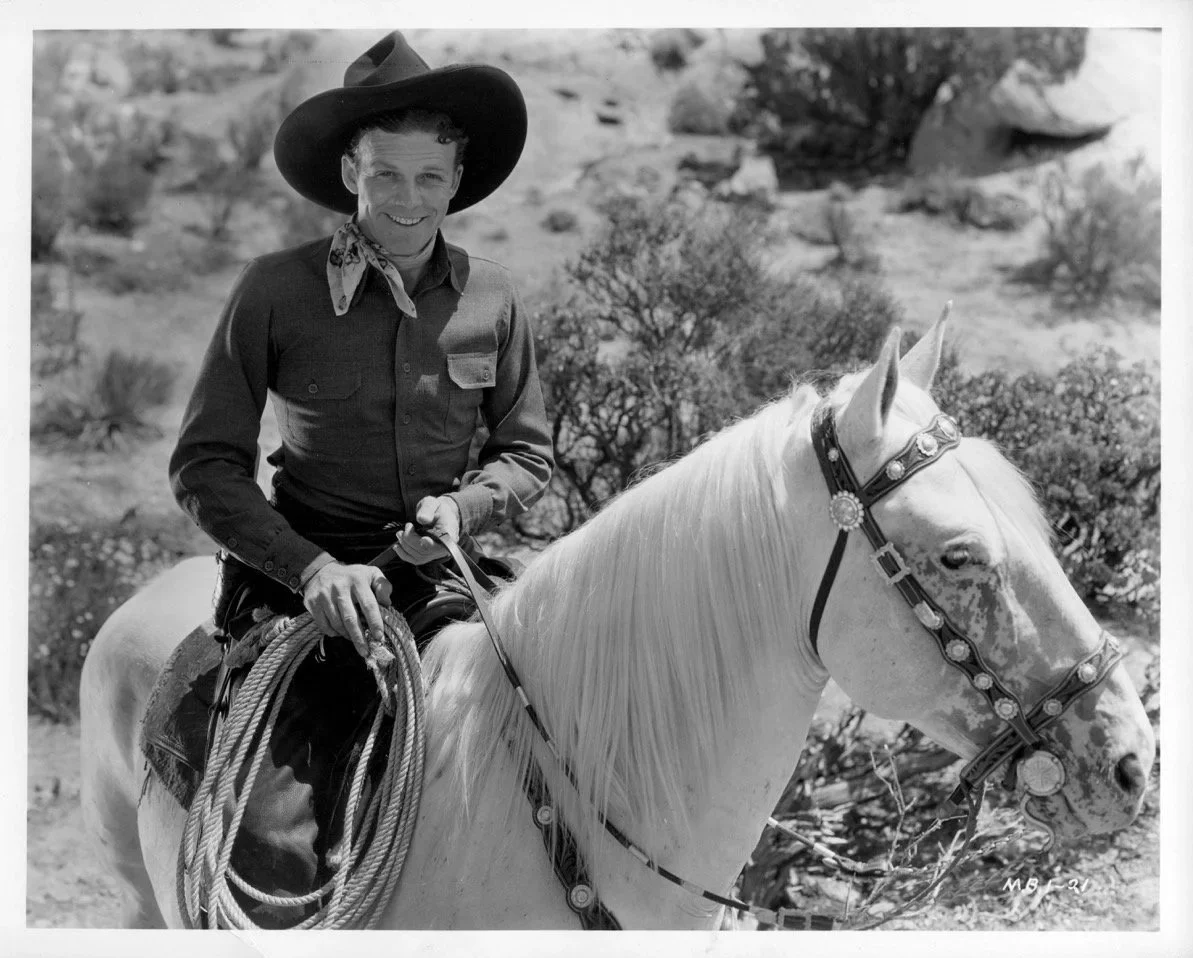
A movie still of Rex Bell.
Beldam was born in Chicago in 1903. He and his family moved to Hollywood in the 1920s, where his rugged good looks and natural charisma as well as his skill with horses made him the perfect fit for the booming Western film genre. He was soon offered a contract with Fox studios. His name, however, did not have the right cowboy ring to it, so he chose the stage name “Rex Bell”. Soon, he was a recognizable face in dozens of Westerns, including “The Cowboy Kid” (1928) and “They Had to See Paris” (1929). However, the film that would change his trajectory was “True to the Navy” (1930), a romance where he starred alongside the vivacious “It Girl” of the silent film era, Clara Bow.
THE COWBOY BEHIND THE SCREEN
Rex Bell’s life took a dramatic turn when he met Clara, sparking a whirlwind romance that led them to elope in Las Vegas in 1931. Their marriage marked the beginning of a new chapter that would leave its mark forever on Nevada. Now intertwined with Hollywood’s most beloved silent film star, Bell’s fame reached new heights, with one newspaper noting that the “former melodrama star and husband of Clara Bow, [had] won the unanimous praise of theater audiences” (News Observer, 1934). While he was often introduced in the tabloids merely as “Clara Bow’s husband,” Bell began creating a reputation of his own and building his bonafides into something remarkable at the location that was eventually to become known as Walking Box Ranch.
The name came from the box-shaped motion picture cameras used in Hollywood; the 400,000 acre-ranch in Searchlight, Nevada became a bridge between two worlds—where the glamor of the entertainment industry met the grit of frontier life. Here, Bell would live the dream that Westerns are made of. “It is a great relief to get away from Hollywood,” Clara Bow had told the Las Vegas Age in 1933, “I can really feel free and enjoy myself. I love the desert and hope to spend every available day on the ranch.” Nevada represented respite for Clara, but for Rex, it represented that and something more—opportunity.
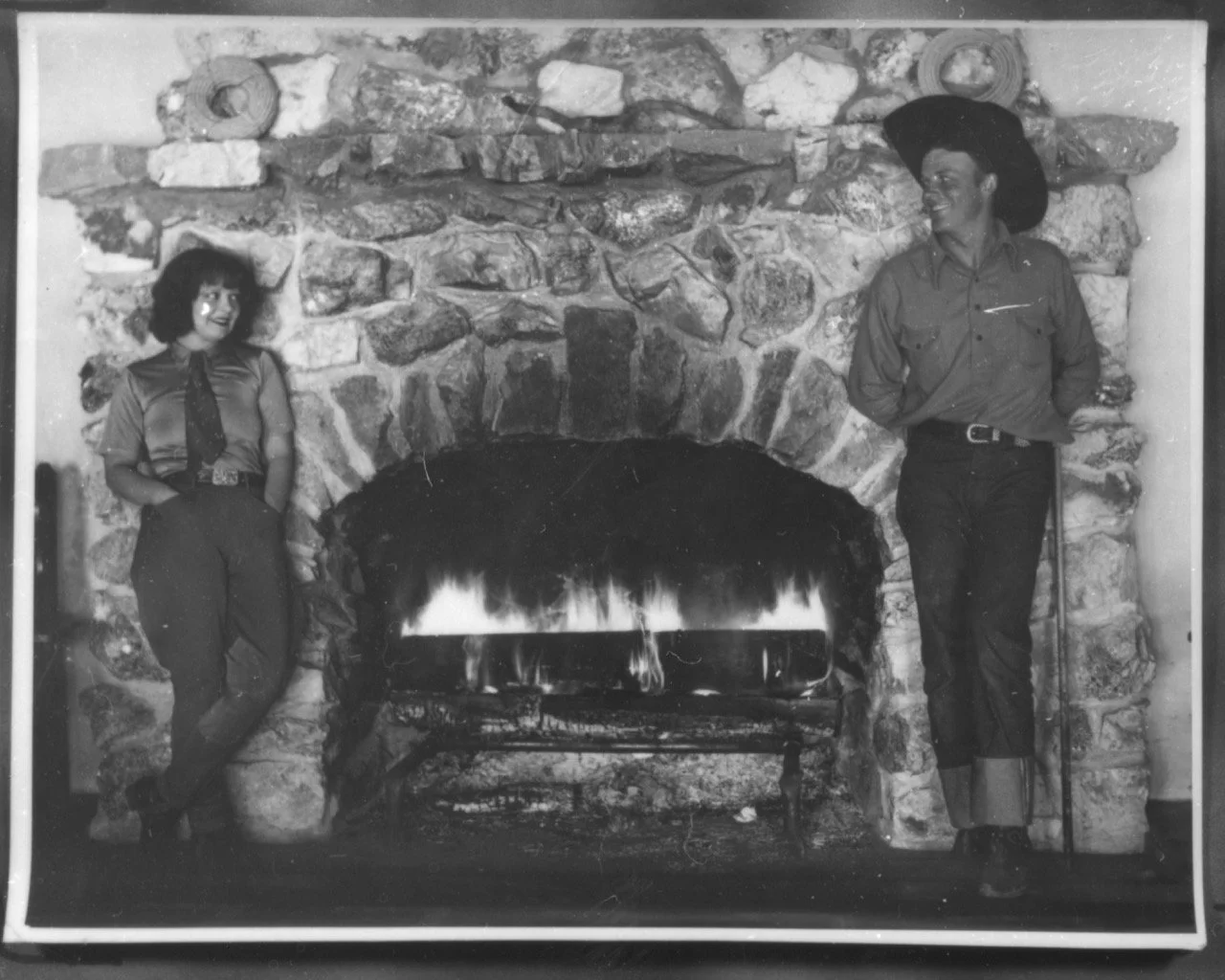
Rex and Clara in front of the fireplace of their ranch home.
While Clara sought refuge from the relentless publicity and litigation that had nearly bro- ken her spirit, Rex saw the potential to transform his Hollywood persona into something au- thentic and lasting. Raising his cattle, riding horses, and tending to their rock gardens, Rex found himself and his purpose in being a real cowboy. Though Clara subsequently retired from acting, Rex continued to travel back to California over the years to star in dozens of productions from “Broadway to Cheyenne” (1932) and “Idaho Kid” (1936), to his final film “The Misfits” (1961), also starring Marilyn Monroe. Even with frequent visits to Hollywood, the allure of the Mojave Desert prevailed and home would perpetually mean Nevada to Rex Bell.
Dr. Michael Green, UNLV History Professor, notes this crucial distinction. “Rex Bell and Clara Bow were really the first, or at least most prominent, Hollywood stars to play a role of any significance in Nevada. This was before gambling spread widely and big-name entertainment became part of the equation.” Their Spanish Colonial-Revival home quickly became a celebrity retreat during a time when nearby Las Vegas had a population of only 5,000. Western film icons like William “Hopalong Cassidy” Boyd, Red Rider, Roy Rogers, and other Hollywood lu- minaries like Clark Gable and Carole Lombard found their way to Walking Box Ranch. Though the location was obscure for the time, for many years Walking Box was Nevada’s second-largest ranch, playing an integral role in the state’s economic development. This stands in stark contrast to what originally drew Bell and other stars to Nevada—the allure of privacy and simplicity— as opposed to the bright lights that define the region today.
BUSINESS MEETS NEVADA BRANDING
As the pair embraced their ranching lifestyle over the years, raising their two sons Rex Jr. and George, Rex’s entrepreneurial spirit could not be tamed. He pursued many new ventures in Nevada’s relative infancy, launching Rexco Inc. in 1944. Under the Rexco umbrella were multiple souvenir shops in Las Vegas and Reno, as well as the clothing label, Walking Box Brand—a tangible blend of Western authenticity and show-business flair. UNLV Professor and fashion historian Deirdre Clemente explains “[The brand] was an extension of Rex Bell’s celebrity and it capitalized on a movement in American culture at the time that was cele- brating Western clothing and a Western aesthetic to not just the West, but to the country at large.”
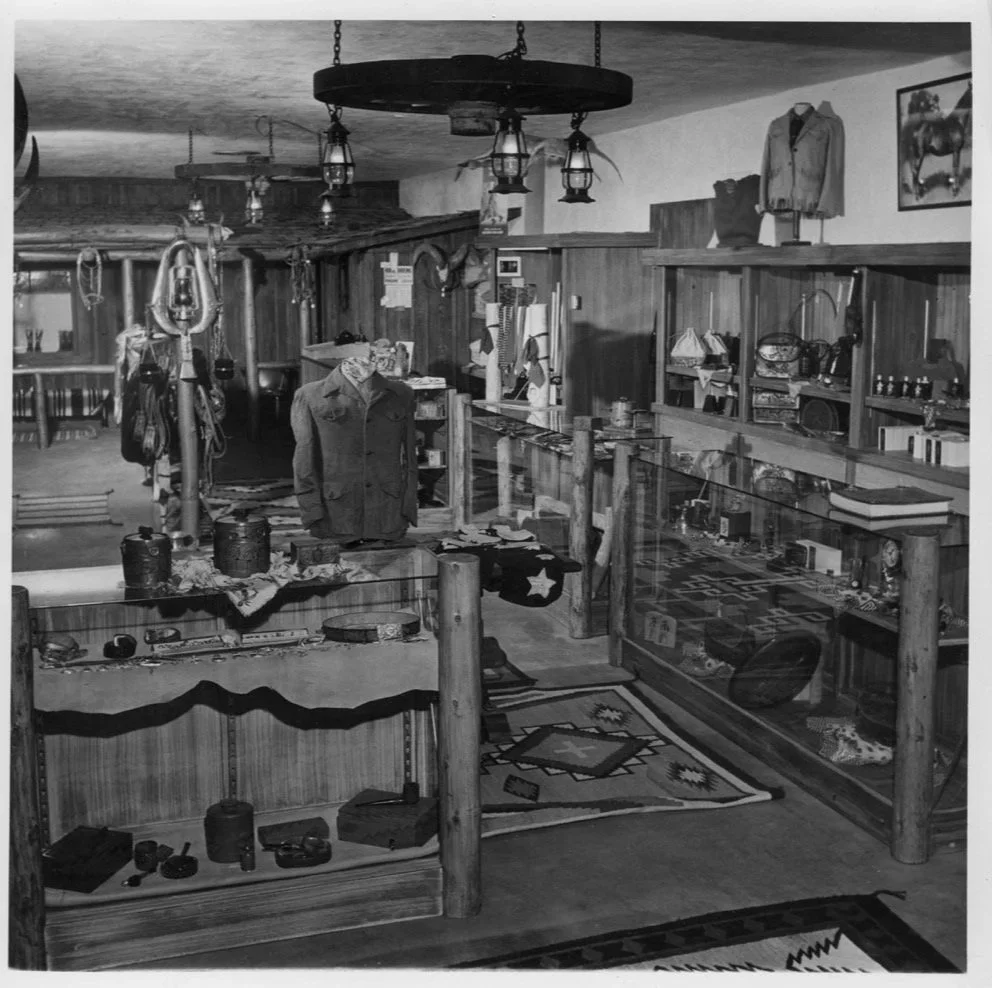
An interior view of Bell’s westernwear store.
The distinctive western wear featured designer Viola Grae’s hand-embroidered desert flora and fauna, celebrating Nevada’s natural heritage. “The craftsmanship made them great,” Dr. Clem- ente emphasizes. “A lot of the motifs of the clothing are cacti and flora that are specific to Nevada, so [Bell] really did make sure that we spoke to the environment from Nevada.” Rex Bell’s Western Wear store on Fremont Street became a landmark in early Las Vegas, offering not just clothing but a taste of authentic Western lifestyle and a way visitors can take home a piece of Nevada.
POLITICAL ASPIRATIONS UNFOLD
As Clara Bow retreated further from the public eye, Rex Bell’s new businesses expanded, and in turn, his profile rose. Marking yet another evolution, Rex’s natural charisma and genuine connection to Nevada’s people led him into politics. This transition was exciting for him. However, being thrust back into the limelight took a toll on Clara, contributing to their split in the mid-40s (the couple never divorced but lived separate lives). When Bow moved back to Cal- ifornia, Bell maintained his passion for Nevada and his political presence continued to flourish. He was a leader in the Republican party and active in the Nevada Chamber of Commerce and Boy Scouts. Most prominently, Bell served as Lieutenant Governor from 1954 until his death in 1962, bringing his characteristic authenticity to public service. As he told the Nevada State Journal in 1954, “Nevada needs leadership that understands both its heritage and its future potential. I’ve lived that heritage, and I believe in our future.”
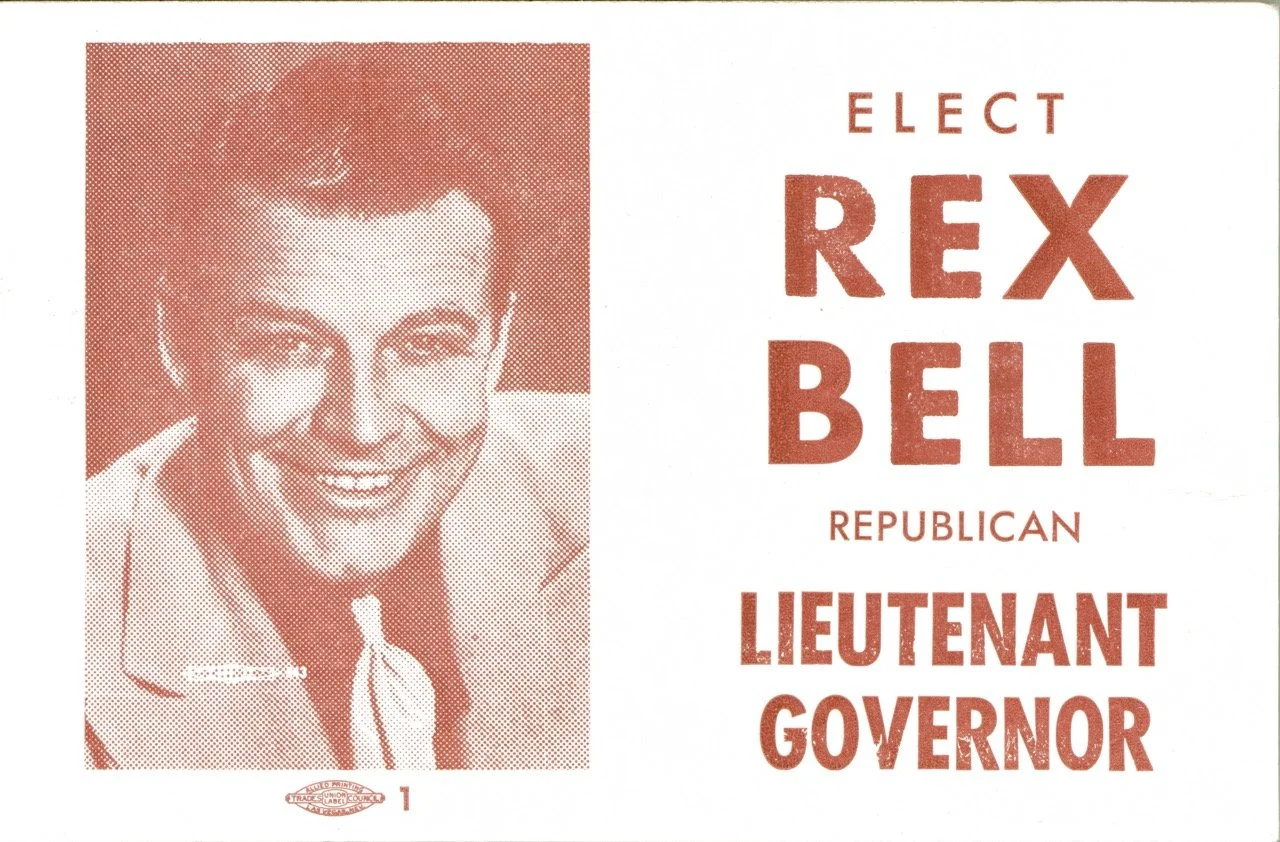
“Fewer celebrities entered politics themselves when he started out,” Dr. Green explains. “His first campaign was more than 20 years before Ronald Reagan ran for governor of California. It’s also worth remembering that in the era in which he was part of Nevada politics, it was easier and possible to know a lot of constituents by name and to meet much of the voting populace.
He liked that part of the political game and the people liked him.” Bell’s approach to politics was distinctly Nevadan in that it was practical and personable. Because he truly “walked the walk” at Walking Box Ranch, he had great appeal to Nevada’s voters.
“His business helped re- duce any distance between a big- name celebrity and the average Nevadan, making Bell even more likable.” Green notes that even Democrats would comment on what a nice guy he was regardless of his party affiliation, an incredible feat by today’s standards. His pervasiveness was cut short, however, in 1962, when Bell suffered a fatal heart attack while filing his candidacy for Governor. Dr. Green reflects poignantly, “He had a better chance than anyone in his party did of defeating the incumbent, Democrat Grant Sawyer. Had Rex Bell lived, it’s interesting to ponder how far he might have gone.”
REX BELL’S ENDURING IMPACT
Bell’s influence on Nevada extended far beyond his lifetime. His vision of Nevada as a place where Western heritage could coexist with modern progress helped shape the state’s development philosophy. Today, the Rex Bell Elementary School in Las Vegas bears his name, and the Walking Box Brand clothing line remains a collectible that encapsulates the spirit of Nevada’s Wild West—an era that is rapidly fading as modernization reshapes the landscape. Perhaps offering us the most insights today into Bell and Bow’s past is Walking Box Ranch. As part of Avi Kwa Ame National Monument, their special retreat and many of their belongings have been preserved, serving as a living laboratory for cultural research, and further emphasizing Bell’s significance to Nevada. Artifacts from the lives of Rex Bell and Clara Bow also reside at the Nevada State Museum, The Clark County Museum, the Searchlight Museum and UNLV.
In the collection of artifacts from Walking Box Ranch is one of the most personal and lasting symbols of Rex Bell’s connections to Nevada—his cream-felt cowboy hat and case. Signed by Rex, Clara Bow, and their movie star friends, this hat is covered in handwritten messages that echo Rex’s warm, genuine relationships with those he met in Nevada and beyond. The hat stands as a timeless memento of Bell’s impact, memorializing the friendships and legacy he left in the state he loved, with autographs including; “Best Wishes Rex Bell, Clara Bow,” “The Westerner,” “Tonto, ‘Getum up Scout,” “The Lone Ranger ‘Hi Ho Silver,” “Little Beaver ‘You Betum, Red Ryder,” “California Carlson,” and “Hopalong Cassidy.”
The stories of Rex Bell’s many roles and connections, born out of the unlikely town of Searchlight, serve as a beacon of inspiration and guidance: in Nevada, one need not choose be- tween preserving the past and embracing progress, between publicity and simplicity, or between dreaming and doing. As Rex Bell demonstrated, it is possible to embody all these facets and more, making life’s journey far more compelling than any Hollywood script.
Photographs courtesy of Walking Box Ranch Photograph Collection, 1880-1979. PH-00346. Special Collections and Archives, University Libraries, University of Nevada, Las Vegas. Las Vegas, Nevada.