How to Play Faro
Faro is a 17th century French gambling game (yes, named after Egyptian Pharoahs) that evolved from the even earlier Italian game of Bassetta that goes back to 1478.
Playing Faro is also referred to as “Bucking the Tiger.” Faro came to the U.S. via New Orleans in the 1700s, and by 1825 it was the most popular game of American saloons and the Wild West, more popular than all other gambling games combined.
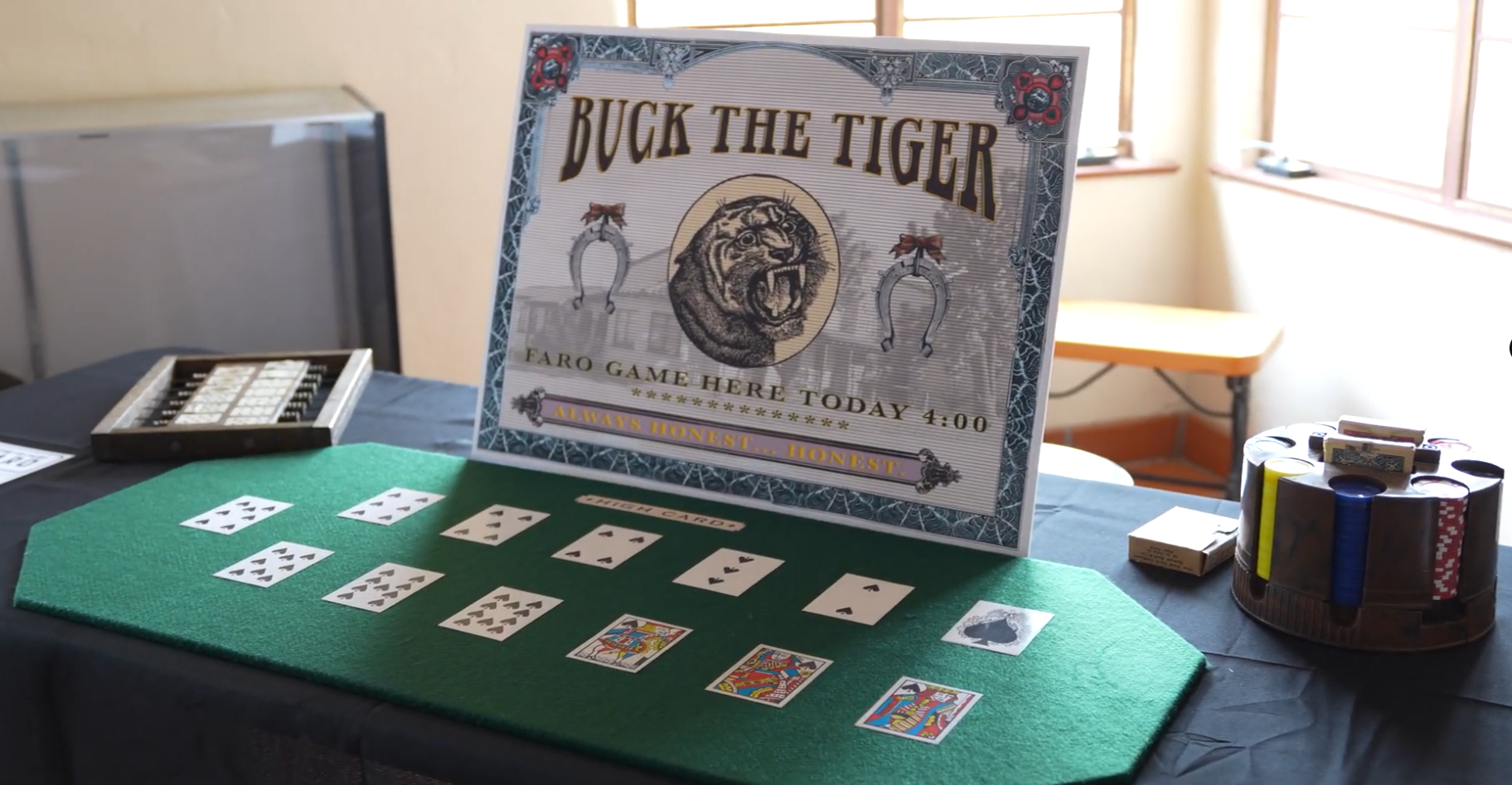
To play, one person is the dealer, and arranges one full suite of cards (usually spades) on a board for players to bet on, by placing chips on the card they think will win.
The dealer uses a separate deck to deal out two cards at a time face up (after discarding the top card). The first of the two cards is the losing card, and the second is the winner. Winners double their money. Players can also bet on the second card being the high card, or bet on multiple cards at once, and can even put a penny (a copper) atop their bet to reverse it (now the losing card drawn is the winning card!), and there are many other quirky options for winning and losing your money.
Throughout the process, players keep track of the already dealt cards with the help of an abacus, usually operated by the dealer's assistant, so they know not to bet on “dead” cards. The last three cards of the game give an opportunity for a riskier and higher stakes bet, worth 4 times the money risked, as players try to guess the order in which the cards will appear.
Faro’s popularity declined around 1915, partly because dealers and players had found so many ways to cheat, which led to more restrictive laws. The last public Faro game was played in Reno in 1985.
How to Play Faro can be found in Issue #4 of the Gold Beam!