THE PLEIADES: ETERNAL SISTERS WHISPERING ACROSS MILLENNIA
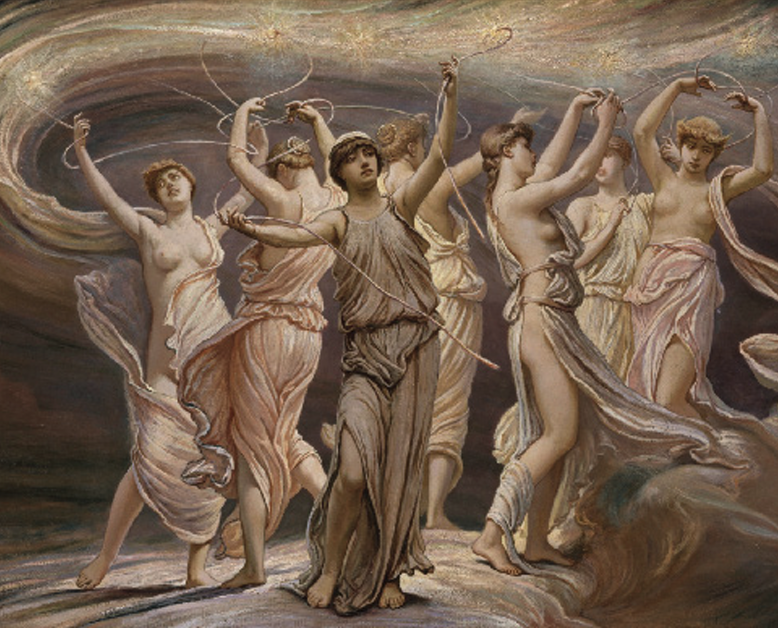
In the vast cosmic theater, few sights evoke a deeper sense of time's passage than the Pleiades, that shimmering cluster of stars in the constellation Taurus. Often called the Seven Sisters, this open star cluster has captured human imagination for at least 10,000 years—possibly the oldest continuously told story in our species' history. As we delve into the theme of time travel for this edition of the Gold Beam, the Pleiades serve as a perfect celestial bridge, linking ancient myths, human memory, and the evolving night sky. Gazing at them isn't just stargazing; it's a journey backward through epochs, where stars become vessels for our collective past.
Astronomically, the Pleiades are a young family of stars, born from the same interstellar cloud about 100 million years ago. To the naked eye, they appear as a tight knot of blue-white gems, visible worldwide during winter evenings in the Northern Hemisphere. But here's where time intrudes: ancient observers, from Greek poets to Indigenous storytellers, consistently described seven bright stars. Today, most people spot only six. What happened to the "lost" sister? It's not a vanishing act but a subtle dimming. The star Pleione, one of the faintest, has varied in brightness over centuries, possibly due to surrounding dust or its own rotational quirks. Some astronomers speculating that atmospheric changes on Earth—thicker pollution or shifting climates—have veiled it further. This evolution mirrors the theme of Avi Kwa Ame's transforming landscape: just as erosion and human impact reshape sacred mountains, cosmic dust and time alter our view of the heavens.
Culturally, the Pleiades weave a tapestry of myths that span continents and eras, like a chronological collage, blending prehistoric cave art with modern astronomical observatories. In Greek lore, the sisters are the daughters of Atlas and Pleione, transformed into stars to escape the hunter Orion—a tale echoed in Roman writings and Renaissance paintings. However, this narrative is a relative newcomer compared to Indigenous traditions. Australian Aboriginal Dream-time stories depict the sisters as young women pursued across the sky, their cluster marking seasonal rains and ceremonies that have persisted for millennia. Closer to Avi Kwa Ame, Native American tribes like the Kiowa and Cherokee tell of seven sisters who ascended to the stars after dancing around a campfire, becoming guides for harvest and migration. The Mojave people, stewards of Avi Kwa Ame's petroglyph-adorned canyons, integrate stellar observations into their oral histories, where the Pleiades signal renewal amid the desert's timeless cycles.
These stories aren't mere folklore; they're humanity's memory encoded in the stars. Archaeological evidence, including 17,000-year-old cave paintings in Lascaux, France, suggests early humans tracked the Pleiades for calendars, aligning solstices and equinoxes. In Mesoamerica, Mayan codices refer to them as "Tzab," the rattlesnake's tail, timing agricultural rites. Even in Japan, as Subaru (“unite" in Japanese), they symbolize harmony across generations. This global resonance hints at a shared ancestral origin, perhaps from migrations out of Africa, carrying the tale like a genetic heirloom.
As we ponder time travel, consider this: light from the Pleiades takes 444 years to reach us. When you spot the Sisters this year, you're seeing the stars as they shone in the 1580s—during Shakespeare's era, or when Spanish explorers first mapped the American Southwest. It's a literal backward glance, inviting us to reflect on how myths preserve memory against oblivion. In Avi Kwa Ame's shadow, where ancient rock art meets modern conservation, the Pleiades remind us that history isn't linear but a collage: overlapping layers of wonder, loss, and rediscovery. Inspirational? Absolutely. Accessible? Grab binoculars on a clear night—the Sisters await, timeless and inviting. They challenge us to honor the past while navigating the future, one starry step at a time.