Spirit Mountain: A Geologic History

by Will Joseph
The peaks that comprise Avi Kwa Ame (Spirit Mountain) produce a striking vis- age when observed in the afternoon sun from the adjoining Piute Valley. The white-tan crest stands out against the deep brown foothills that flank Spirit Mountain to the north and south. The rocks that make up Spirit Mountain and the larger Newberry Mountain range extend roughly from Searchlight in the north to the south near Laughlin, and the range is mantled by the Colorado River in the east.
A closer examination of the canyons and trails that ascend the slopes reveal its complex history, not only culturally (with evidence of human occupation extending back thousands of years) but geologically, where the mountain’s origins can be traced back to over a billion years of Earth’s history. The Colorado River tribes have revered Avi Kwa Ame since time beyond memory, and geologists from around the world also study its wonders and marvel at its timeless features.
Faults, magmatic intrusions, lava flows, and rocks exhumed from deep beneath the Earth’s surface are a part of Spirit Mountain’s vast history. Erosive forces have ex- posed these geologic features and provide an understanding of how the landscape has formed over many eons, giving geologists a window deep into the past.
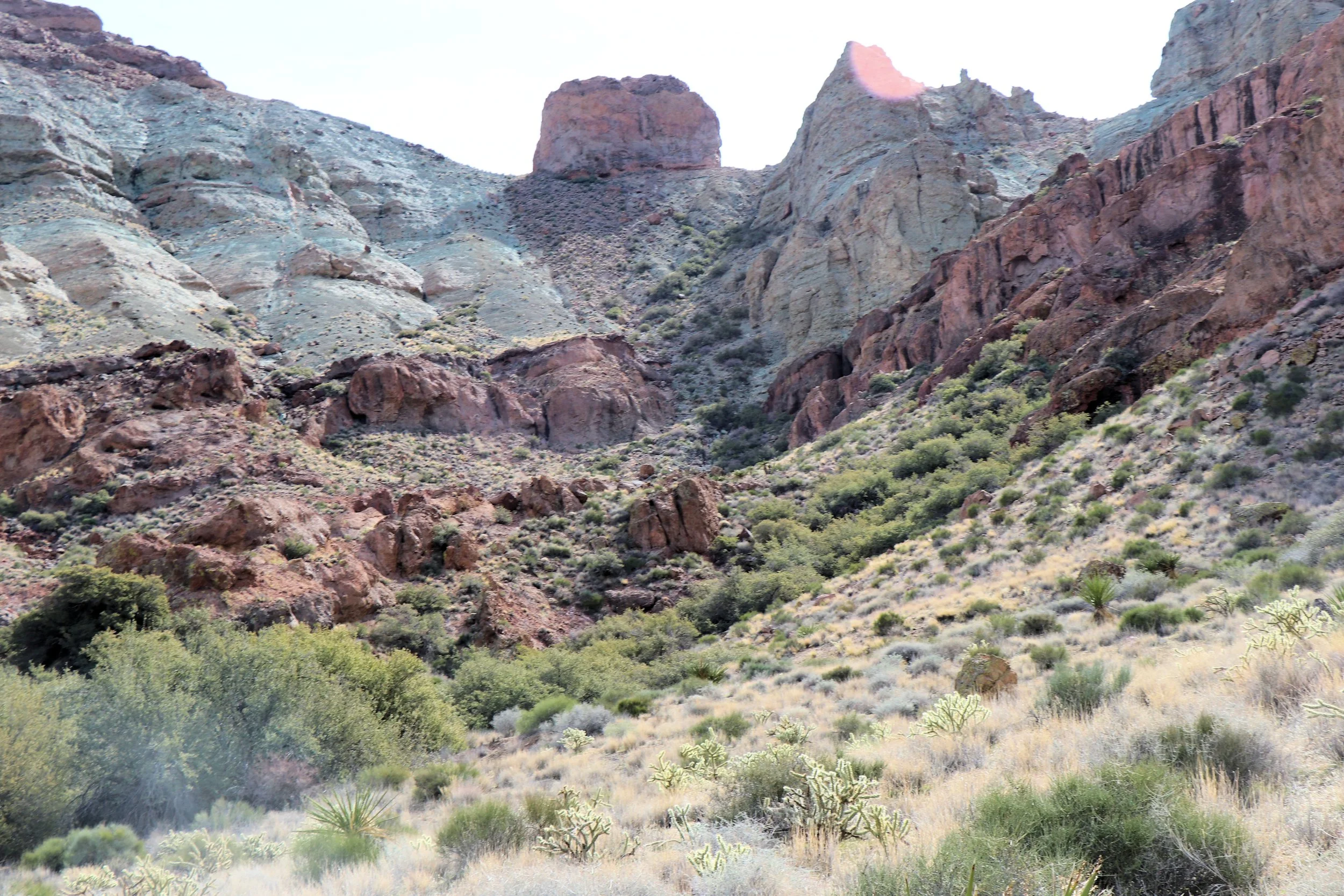
East Side of the Highland Range. Photo by Alan O’Neill.
These mountains were formed largely due to a relatively violent era in Nevada’s geo- logic history. Around 22 million years ago, magmatic activites (magma is molten rock material within the earth) moved northward from Arizona towards Lake Mead over a span of approximately 10 million years. This magmatism was in response to a thinning of the earth’s crust, referred to as extension. The extension of the earth’s crust occurs on normal faults where rocks pull apart and drop down. Extensional faulting and its associated volcanic activity reached the Spirit Mountain area around 17 million years ago.
When extension occurs, the thinning of the Earth’s crust provides zones of weak- ness which allow magma to reach the earth’s surface. This can lead to the forma- tion of volcanoes which erupt vast amounts of lava and ash. One such eruption produced an ignimbrite (a rock composed of hardened volcanic ash) deposit known as the Peach Springs Tuff. The Peach Springs Tuff erupted approximately 19 mil- lion years ago from a volcanic center roughly 40 kilometers southeast of Spirit Mountain, near Oatman, AZ. The material ejected from this eruption covers an area of approximately 32,000 square kilometers (an area twenty times larger than the Las Vegas Valley).
However, not all this magma reaches the surface; instead, some of it cools down slowly within the earth’s crust. These underground magma chambers are known as plutons or batholiths (plutons are smaller, individual magma chambers and batholiths are much larger ones con- sisting of many plutons). Plutons are commonly composed of crystalline rocks known as granites. The formation of Avi Kwa Ame can be attributed largely to the intrusion of granitic magma around 15 to 17 million years ago, ultimately forming what is known as the Spirit Mountain Batholith.
The white colored granitic rock of the Spirit Mountain Batholith is easily recog- nizable when viewing Avi Kwa Ame from the west. However, dark units to the north of the pluton are composed of granites and gneisses (metamorphic rock) that range in age from the Proterozoic to Late Cretaceous periods (1.7 billion to 65 million years ago). These older rocks can be seen on Spirit Mountain due to extension- al faults exposing and rotating deep metamorphic rocks towards the earth’s surface. The Spirit Mountain Batholith then intruded along these faults and cut through the older strata.
The geologic history of Spirit Mountain is one that spans deep into the past and into a timeline that is hard to comprehend. Human life is infinitesimal when compared to the billion-year history that built Avi Kwa Ame and the surrounding mountains. As geologists (and humans), we seek to understand the unfathomable but, in the end, we often find ourselves humbled by the sheer magnitude of this special place.
REFERENCES:
Claiborne, Lily L., Calvin F. Miller, and Joseph L. Wooden. "Trace element composition of igneous zircon: a thermal and compositional record of the accumulation and evolution of a large silicic batho- lith, Spirit Mountain, Nevada." Contributions to Mineralogy and Petrology 160 (2010): 511-531.
Faulds, James E., et al. "Cenozoic evolution of the northern Colorado River extensional corridor, southern Nevada and northwest Arizona." (2001): 239-271.
Ferguson, Charles A., William C. McIntosh, and Calvin F. Miller. "Silver Creek caldera—The tecton- ically dismembered source of the Peach Spring Tuff." Geology 41.1 (2013): 3-6.
House, P. Kyle, et al. "Surficial geologic map of the Spirit Mountain SE and part of the Spirit Moun- tain NE 7.5' quadrangles, Nevada and Arizona." US Geological Survey Scientific Investigations Map 3448, scale 1: 24,000 (2020): 30.
Lang, Nicholas P., et al. "The Spirit Mountain batholith and Secret Pass Canyon volcanic center: A cross-sectional view of the magmatic architecture of the uppermost crust of an extensional terrain, Colorado River, Nevada-Arizona." (2008).
Valentine, Greg A., David C. Buesch, and Richard V. Fisher. "Basal layered deposits of the Peach Springs Tuff, northwestern Arizona, USA." Bulletin of Volcanology 51 (1989): 395-414.